

What actually decides your EV’s charging speed?
When you make the switch to electric, there are a few new things to learn about how your car takes on energy. Both your EV and the charger are sophisticated pieces of technology, constantly communicating with each other to work out how much power can safely be delivered.
The number written on a public charger, such as 50 kW, 150 kW or 300 kW, is its maximum available charging power. It doesn’t necessarily mean your EV will receive that amount throughout the entire charging session.
Your EV has its own charging limit
Every EV has a maximum amount of power it can accept.
For example, if your EV has a maximum DC charging rate of 100 kW and you connect it to a 150 kW charger, the car will still only request up to 100 kW.
Connect another EV capable of accepting 250 kW to the same charger and its charging experience could be completely different.
Battery size alone doesn’t determine charging speed either. Charging performance depends on the battery technology, voltage, cooling system, charging software and the way the vehicle has been engineered.
It’s worth checking the specifications for your particular model to find out both its maximum DC charging rate and its maximum AC charging rate.
This is particularly important with AC chargers. For example, your car may be connected to a 22 kW public AC charger, but if its onboard charger can only accept 11 kW, then 11 kW is roughly the maximum you’ll see.
How full is your battery?
Your EV doesn’t usually charge at one constant speed from empty to full.
Instead, it follows what is known as a charging curve.
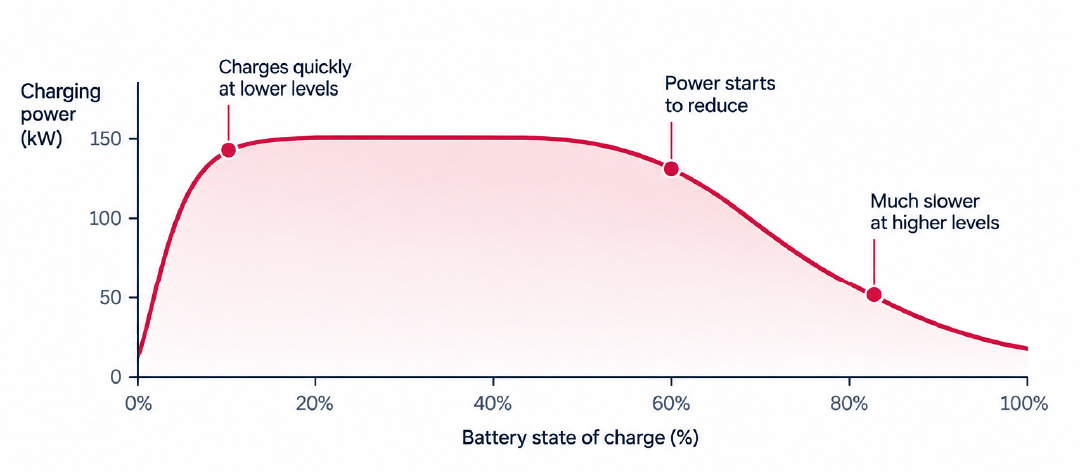
When the conditions are right, your vehicle may accept much higher power when the battery is at a lower state of charge. As the battery fills, the car will gradually begin reducing the amount of power it requests.
This is particularly noticeable as you approach around 80%, although the exact charging curve varies significantly between different vehicles.
That means your EV might reach its advertised peak charging speed for only part of the session.
It’s also why charging from 10% to 80% can be considerably quicker than charging from 80% to 100%.
If you’re on a long journey, stopping for a shorter top up and continuing your journey can sometimes be more time efficient than waiting for the battery to reach 100%.
Battery temperature makes a difference
EV batteries have an ideal operating temperature. If the battery is particularly cold or hot, your vehicle may reduce the amount of charging power it accepts to protect the battery.
This is why you may notice slower rapid charging on a cold winter morning than you would under more favourable conditions.
Many newer EVs have battery preconditioning to help with this.
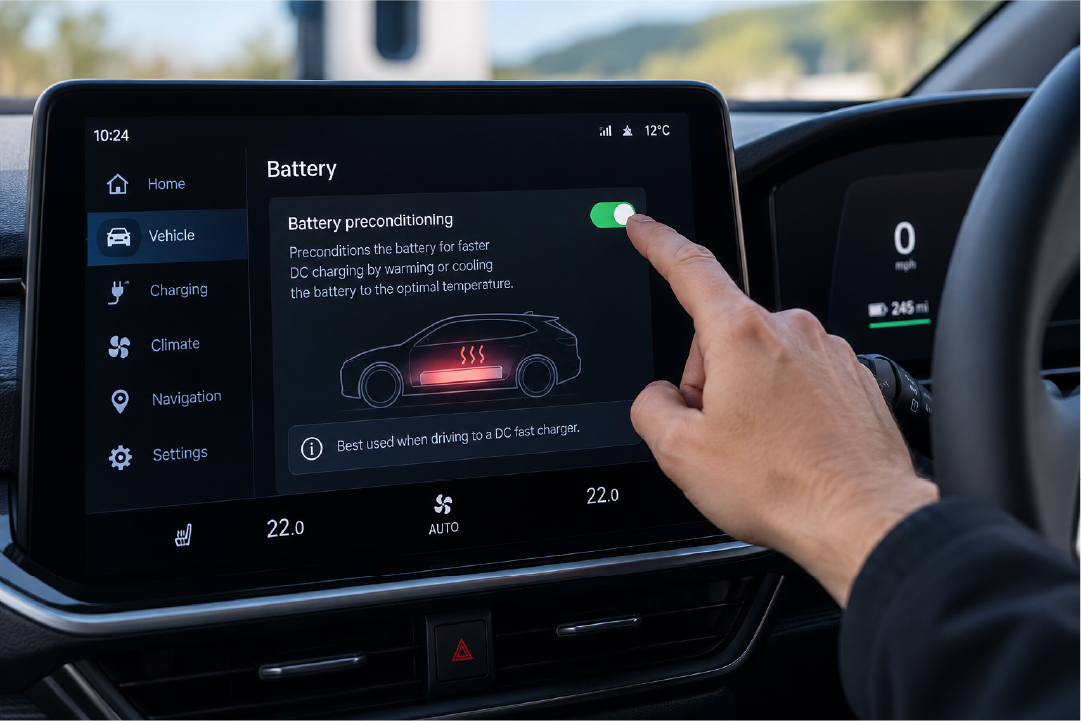
Depending on the vehicle, you may be able to activate battery conditioning manually, or the vehicle may do it automatically when you select a rapid charger as the destination in its built in navigation system.
The car then begins bringing the battery towards a suitable temperature before you arrive at the charger. Some manufacturers says battery preconditioning can involve heating or cooling the battery and commonly takes around 20 to 30 minutes depending on conditions.
Check your vehicle handbook or manufacturer’s app to find out whether your EV has this feature and how to activate it.
Your car and charger have to work together
Charging power is ultimately determined by a combination of voltage and current.
You don’t need to understand all the electrical engineering behind it, but it helps to know that different EVs use different battery architectures and chargers also have limits on the voltage and current they can supply.
When you plug in, the charger and vehicle communicate and agree on what the car can safely accept.
In simple terms, the charger can offer the power, but your EV decides how much it can take.
The charger may be sharing power
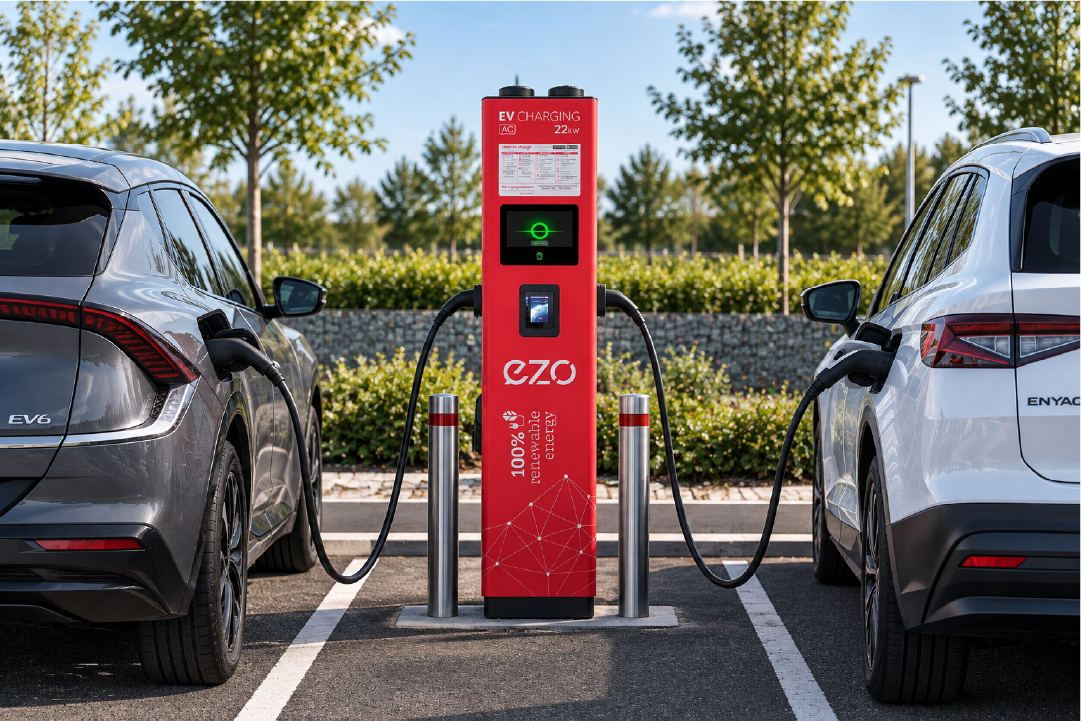
Some public chargers are capable of charging more than one vehicle at the same time. When this happens, the available power may be shared between the vehicles.
But it isn’t always as simple as dividing the number on the charger by two.
Different chargers manage power in different ways. Some may divide capacity between two connectors, while others dynamically distribute power depending on what each vehicle is requesting. For example, modern chargers can dynamically allocate available power between connected vehicles rather than using a permanent 50:50 split.
So if another vehicle plugs into the same charging unit, you may occasionally see your charging rate change.
The site itself can affect charging speed
There’s also a lot going on behind the charger that you don’t see.
Public charging sites have electrical infrastructure including transformers, switchgear, cabling and grid connections. The amount of electricity available to the site can affect how much power can be delivered at any particular moment.
Larger charging hubs may also use intelligent power management to distribute the available electricity between several chargers.
So even though an individual charger is capable of delivering a very high level of power, the wider site also needs to be capable of supporting it.
How can I get the best charging speed?
There are a few simple things you can do:
- Know your EV. Check its maximum AC and DC charging rates so you know what speeds it is capable of accepting.
- Use battery preconditioning where available. Particularly before rapid or ultra rapid charging in very cold or hot conditions.
- Think about your state of charge. Your EV will usually charge more quickly at a lower state of charge and begin slowing as the battery fills.
- Choose the right charger. A 300 kW charger won’t make a vehicle with a 100 kW maximum charging rate charge at 300 kW.
And remember, seeing a number below the charger’s advertised maximum doesn’t automatically mean there’s a fault.
Public charging should be a simple and convenient way to top up your EV, but there’s a lot of clever technology working in the background every time you plug in.
Your vehicle is constantly monitoring the battery and communicating with the charger to determine how much power it can safely accept. Battery level, temperature, the capabilities of your car, charger power and even the wider charging site can all influence the speed you see.
Learning a little about your EV when you first make the switch can make a big difference.
Find out its maximum charging speed, understand how its charging curve behaves and learn whether it has features such as battery preconditioning.
Once you understand those basics, public charging becomes much more predictable.